
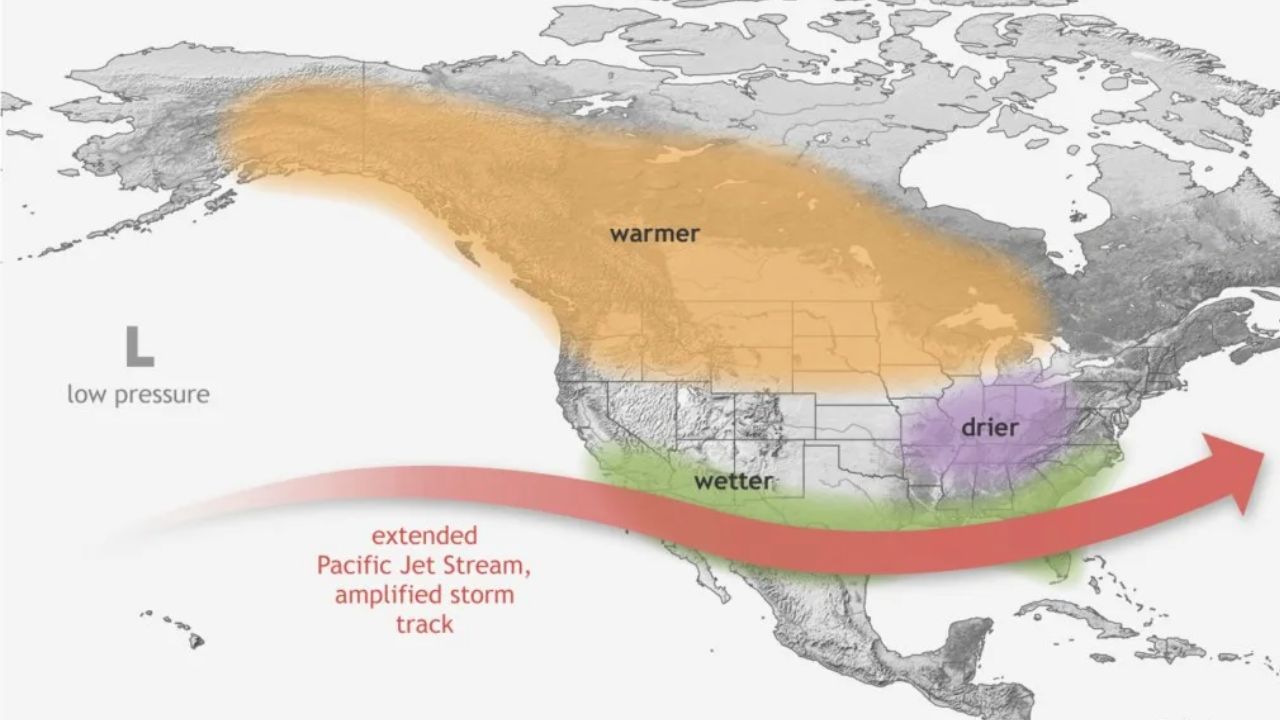
Washington, D.C. — A strengthening El Niño and the seasonal polar vortex could interact this winter, potentially creating short-lived swings toward colder weather across parts of the United States, even as the broader winter pattern remains heavily influenced by Pacific climate patterns.
The National Oceanic and Atmospheric Administration’s Climate Prediction Center said El Niño was strengthening this month, with a greater than 90% chance of a very strong event developing during the fall and winter months.
The agency also put the chance of a historic event during October through December at 75%, meaning the developing El Niño could potentially exceed the strength of previous events recorded since 1950.
But NOAA cautioned that even an El Niño of exceptional strength does not guarantee that every location will experience weather typically associated with the climate pattern.
What El Niño could mean this winter
El Niño is the warm phase of the El Niño-Southern Oscillation, or ENSO, a recurring climate pattern centered in the Pacific Ocean that can influence weather patterns around the world.
Its counterpart, La Niña, represents the cooler phase of the cycle.
A very strong El Niño can influence the position and behavior of large-scale atmospheric patterns, but its effects are not identical everywhere in the United States.
That is one reason forecasters are also watching the stratospheric polar vortex, another feature that can occasionally contribute to significant winter weather changes.
The polar vortex returns each winter
The polar vortex is a large region of cold air and low pressure surrounding the Earth’s poles. According to the National Weather Service, it exists throughout the year but becomes stronger during winter and weaker during summer.
The stratospheric version of the polar vortex develops each year around late August and early September, according to AccuWeather meteorologist Chad Merrill, who spoke with Newsweek.
It generally remains a feature through the colder months before breaking down during spring.
When the vortex is strong, cold air generally remains concentrated closer to the Arctic. When it weakens or becomes disrupted, Arctic air can move farther south into parts of the Northern Hemisphere.
However, that does not automatically mean the United States will experience a major cold wave.
Polar vortex could deliver a temporary cold blast
Merrill described the polar vortex as “a small piece of a larger puzzle” when determining winter conditions across the U.S.
He said El Niño and the Pacific Decadal Oscillation, another large-scale Pacific climate pattern, would likely have greater influence on the overall winter forecast.
A strong polar vortex typically favors warmer-than-average temperatures across parts of the Northern Hemisphere, Merrill said. Even so, other atmospheric patterns can still create cold-air outbreaks while the vortex remains strong.
If the vortex becomes weaker than average, Arctic air can push farther into the Northern Hemisphere. Exactly where that cold air moves — whether toward the U.S., Europe or Asia — depends on the broader atmospheric setup.
A cold outbreak connected to a disrupted polar vortex can also persist for two to three weeks in one region, according to Merrill.
3.1 Earthquake Jolts LA Area Near Compton as Shaking Reaches Long Beach and Glendale
The key period could arrive in January and February
The interaction between a very strong El Niño and the polar vortex could become more important during the second half of winter.
Merrill said that if the stratospheric polar vortex weakens sometime between mid-January and February, it could temporarily shift conditions toward colder-than-average temperatures across the northern United States.
That possibility could create a noticeable change from the larger seasonal pattern, but it would not necessarily redefine the entire winter.
Merrill emphasized that during strong El Niño winters, the polar vortex “doesn’t usually dictate the longer-term pattern for the back half of winter.”
For now, forecasters will continue watching how El Niño develops, how the polar vortex behaves and how the two atmospheric features interact. The combination could produce brief periods of significant cold, but the larger winter pattern will depend on several competing climate and atmospheric influences.
What are you expecting from the U.S. winter this year? Share your thoughts in the comments.
One thought on “Winter Weather Wild Card: Polar Vortex and Super El Niño Could Clash Over the U.S.”