
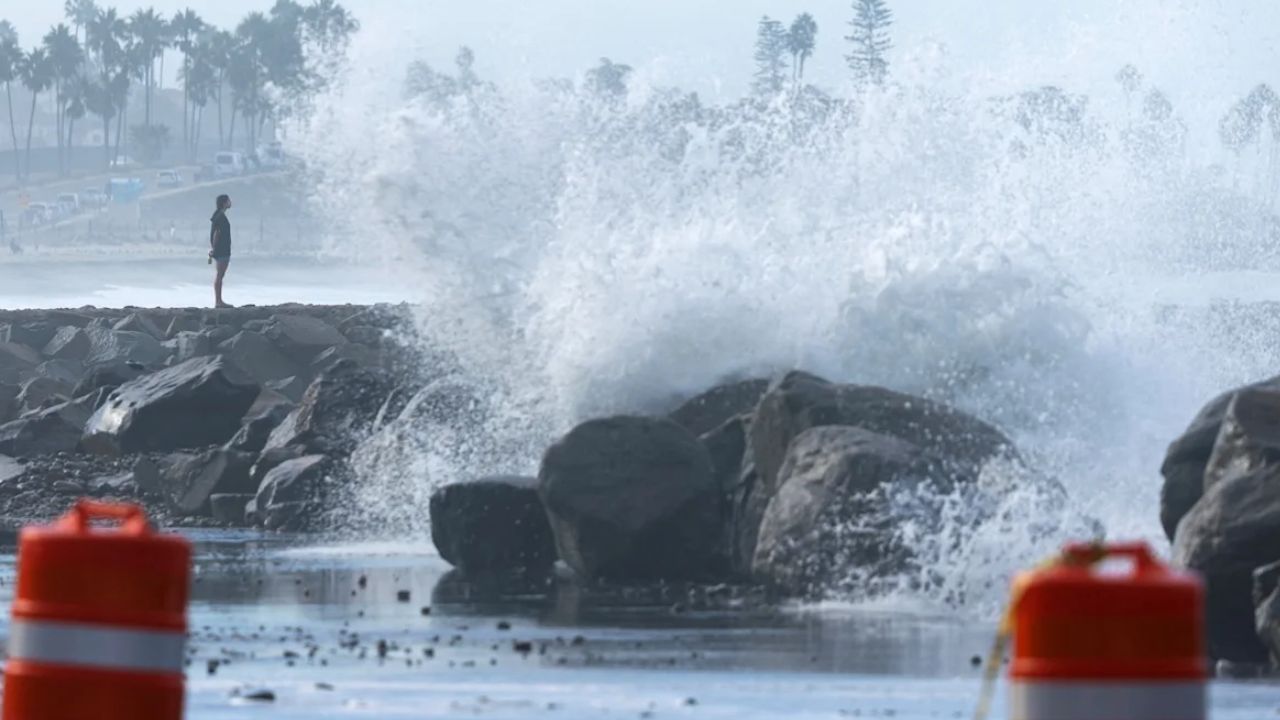
Southern California, CA — The region’s coastline is already taking a significant hit from powerful waves, high water levels and repeated storms, and experts warn that coastal erosion could become even more serious during the coming winter as El Niño strengthens.
Beaches, private residences, parks and roadways have all been affected in communities stretching from Malibu and Laguna Beach to Long Beach, Dana Point and Carlsbad, with ocean waves pushing increasingly close to infrastructure.
Brett Sanders, Chancellor’s Professor of Civil and Environmental Engineering at the University of California, Irvine, said communities need to be highly prepared for what could be an unusually challenging winter.
“We need to be in the highest level of preparedness. This is likely to be the most stressful winter we have had in a number of years in terms of waves,” Sanders said.
The concern comes as Southern California deals with erosion that has already become noticeable during the summer, a period when major coastal erosion events are less common.
El Niño could bring more powerful wave action
Experts say several factors are coming together along the Southern California coast.
A marine heat wave that began developing last winter, combined with strengthening El Niño conditions, has helped provide favorable conditions for tropical systems in the Pacific. Those storms have sent repeated rounds of large waves toward the California coastline.
When those waves arrive around high tide, the combination can significantly increase erosion. Alexander Gershunov, a climate researcher at UC San Diego’s Scripps Institution of Oceanography, said El Niño winters generally bring a greater likelihood of coastal erosion events.
“There is a higher likelihood of coastal erosion events during El Nino winters,” Gershunov said, explaining that stormier conditions in the northeastern Pacific can produce more wave action along California’s coast.
California’s Coastal Commission is also warning residents that the 2026-27 El Niño is strengthening and that coastal communities could experience more frequent and intense storms, rainfall and high-wave conditions during the winter period.
Higher sea levels and tides add another concern
Sanders said sea level along the Southern California coast has been around six inches higher than normal since March because of El Niño.
He expects water levels to peak around November and December as El Niño reaches its strongest phase, with another increase possible in the coming months.
Natural tidal cycles could add another challenge. Sanders said tides during November, December and January are expected to be among the highest seen in several years.
That creates a potentially difficult combination: elevated sea levels, higher tides, winter storms and powerful waves.
Experts say the combined wave energy could put additional pressure on communities located directly along the coastline.
Erosion has already caused major problems
The current conditions are not simply a future concern. Coastal communities have already seen significant impacts.
Adam Young, a coastal geomorphologist at Scripps Institution of Oceanography, described the number of erosion problems appearing across different parts of Southern California as unusual.
“What you are seeing is likely a wake-up call for some of the issues we may be facing this winter,” Young said. “To have so many different erosion issues on so many different parts of the coast is unusual.”
3.1 Earthquake Jolts LA Area Near Compton as Shaking Reaches Long Beach and Glendale
Previous research has also documented the ability of strong El Niño events to produce major coastal changes. A U.S. Geological Survey study found that the 2015-16 El Niño produced significant erosion across California beaches, although the impacts varied substantially from one location to another.
Carlsbad moves to protect coastal infrastructure
Carlsbad is already taking action.
The city declared a local emergency on Sept. 9 after a geotechnical report recommended emergency stabilization of an eroding bluff along South Carlsbad Boulevard. The proposed work includes extending an existing rock revetment approximately 192 feet north to help protect the bluff and roadway.
City Manager Geoff Patnoe said the city has been proactively monitoring infrastructure ahead of storm season. The situation highlights the broader challenge facing Southern California communities as winter approaches.
Do you think Southern California communities are prepared for the coastal conditions expected this winter? Share your thoughts in the comments.