
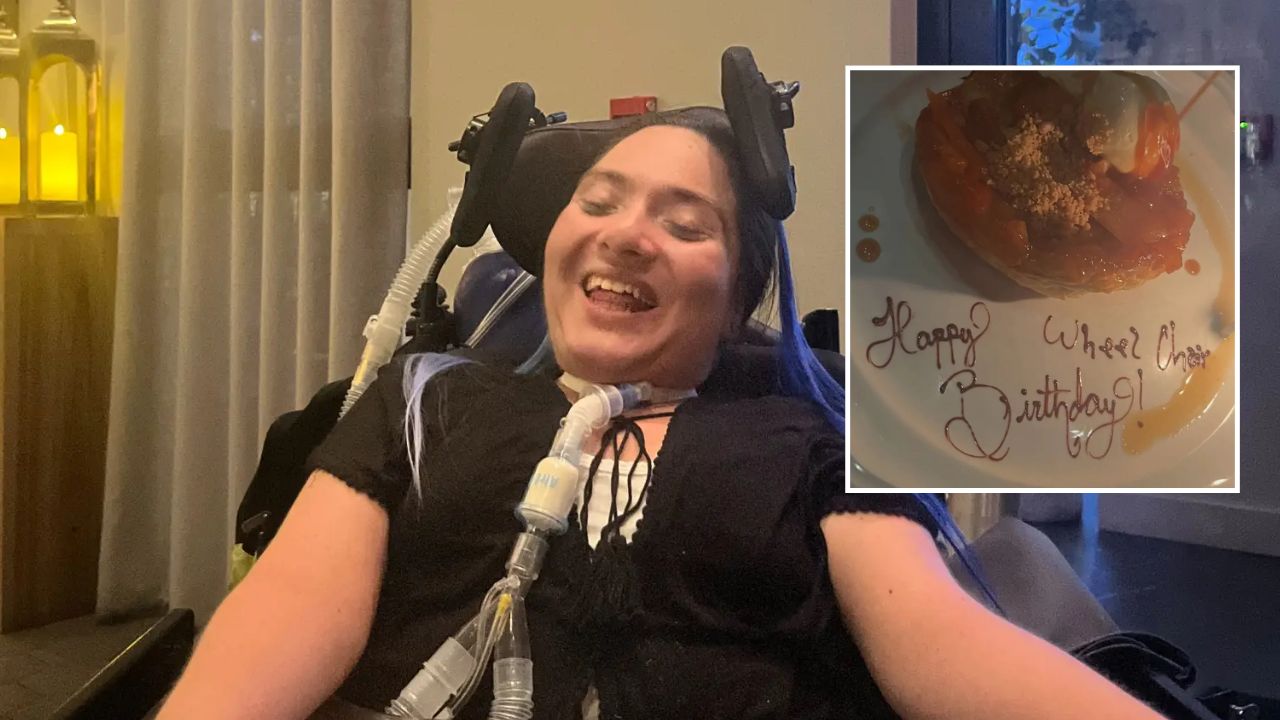
WEEHAWKEN, N.J. — What was supposed to be a special 29th birthday dinner with friends and family turned into an upsetting experience for New Jersey singer-songwriter Antonia Sinbaldi after an upscale restaurant served her dessert with a message she says was deeply offensive.
Sinbaldi was celebrating her birthday at Blu on the Hudson in Weehawken in June when she ordered an Apple Tart Tatin, described as puff pastry served with vanilla ice cream and salted caramel.
When the dessert arrived, however, the message written in sauce across the plate caught her attention.
It read: “Happy Wheel Chair Birthday.”
Sinbaldi had shared a video from the celebration on Instagram showing the dessert arriving as she sat with her loved ones. The message quickly became the focus of what had otherwise been a celebratory evening.
“Not to complain about a fairly new restaurant in my town, but why would you make my dessert say this?” Sinbaldi questioned on Instagram.
Singer Says Her Body Reacted Before She Could Speak
Sinbaldi uses a motorized wheelchair and has required a ventilator following a cervical spinal injury she suffered when she was 2 years old, after a drunk driver struck the vehicle she was riding in.
She said seeing the words on her birthday dessert triggered an immediate physical reaction.
“Body started shaking, body started spasming. My body reacted faster than my mouth or my mind,” Sinbaldi told.
The reaction left her unable to simply walk away from the situation, and her friends and family confronted restaurant management about what had happened.
According to Sinbaldi, the party was offered complimentary drinks following the incident.
But the gesture did little to resolve her concerns about why the word “wheelchair” had appeared directly on her birthday dessert.
“It offended me. This whole thing doesn’t sound real,” Sinbaldi told the outlet.
Restaurant Says Message Was a Staff Misunderstanding
Blu on the Hudson, which opened in 2023, later apologized for what happened.
In a statement, the restaurant said treating every guest with dignity and respect was fundamental to its operations and acknowledged that the message could have been deeply hurtful.
The restaurant explained that its staff normally uses table and seat numbers on tickets to identify where food should be delivered.
According to management, the word “wheelchair” was used internally to identify where a birthday dessert with a candle was supposed to go because Sinbaldi was the diner using a wheelchair.
The restaurant said that notation was then misunderstood and accidentally written on the plate itself.
“There was absolutely no malicious or disrespectful intent behind the notation,” management said.
However, the restaurant also acknowledged that seeing the word written on the plate could understandably be upsetting.
The apology did not fully satisfy Sinbaldi.
‘My Chair Is Not My Identity’
Sinbaldi pushed back against the restaurant’s explanation, describing it as a “bs response.” She also took to Instagram to explain why the incident affected her so strongly.
“My chair is not my identity,” Sinbaldi wrote.
7-Year-Old Boy Was Picking Out a Push Pop at Walmart When Random Man Slashed Him From Behind
For Sinbaldi, the issue was not simply the words themselves. She said the incident reflected a broader problem with the way people sometimes focus on her disability rather than treating her like anyone else. As a disability rights advocate, she hopes the experience can serve as a lesson for others.
“Don’t bring my disability [up] in every sentence, is what people, they should know,” she told.
Her message comes after what she expected to be a simple birthday dinner surrounded by people close to her.
Singer Hopes Incident Sparks More Awareness
Sinbaldi’s experience has sparked discussion about how businesses and individuals should communicate when accommodating customers with disabilities.
While the restaurant maintains that the wording originated from an internal seating reference and was never intended as an insult, Sinbaldi said the impact of seeing those words on her birthday dessert was difficult to separate from the explanation.
The incident has left both sides emphasizing different aspects of what happened: the restaurant pointing to a miscommunication among staff, and Sinbaldi emphasizing the emotional impact of having her disability singled out during a personal celebration.
For Sinbaldi, the larger lesson is about seeing people beyond their disabilities and understanding that a wheelchair is only one part of a person’s life—not their identity.
What do you think about the restaurant’s explanation and Sinbaldi’s response? Share your thoughts in the comments.