
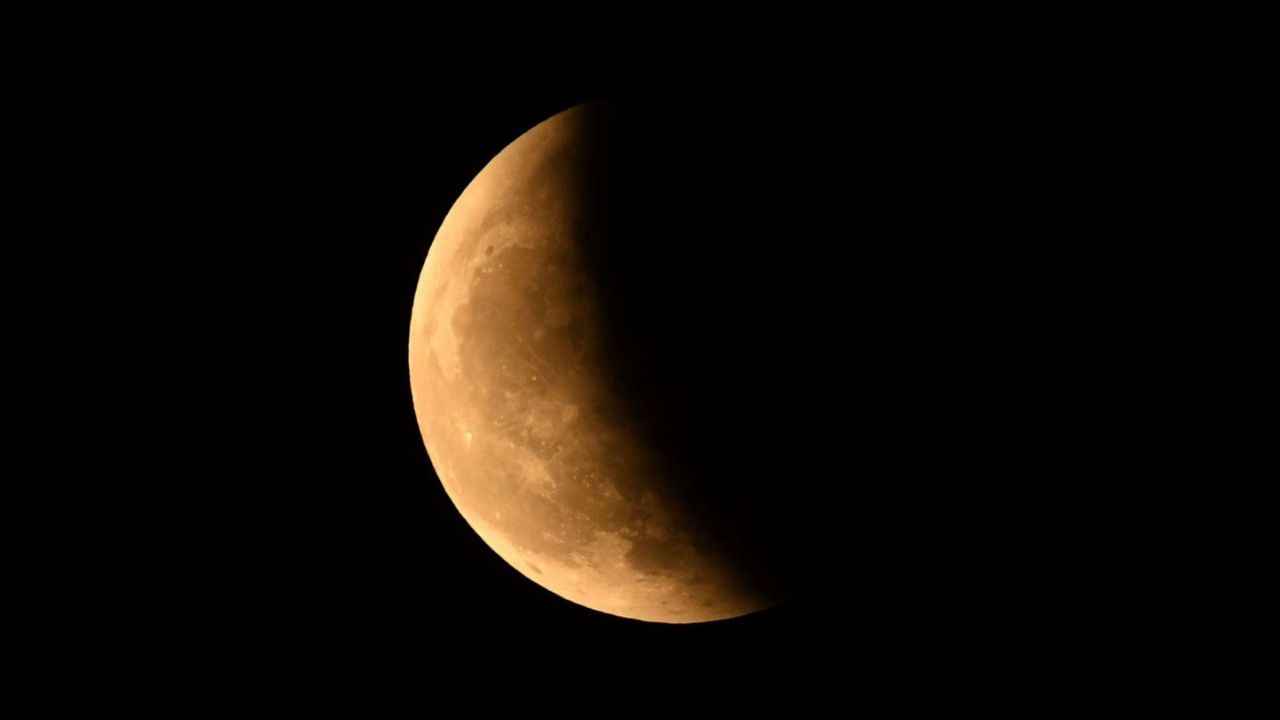
United States – Across much of the contiguous United States, skywatchers will have an opportunity Thursday night to see one of the most impressive lunar eclipses in years, with almost the entire moon disappearing into Earth’s darkest shadow.
During the partial lunar eclipse, about 96% of the moon will be covered by Earth’s umbra, the innermost and darkest portion of the planet’s shadow.
That will leave only a small sliver of the lunar surface illuminated directly by the sun.
The event is expected to be particularly striking near its peak, when the moon may take on a coppery or reddish color. According to NASA, this effect is similar to the reddish appearance often associated with a total lunar eclipse.
As the eclipse progresses, the reddish hue should become easier to notice, potentially creating a dramatic view for people watching from locations with clear skies.
For the contiguous United States, this eclipse is especially notable because it is expected to be the best lunar eclipse visible until June 25-26, 2029.
What Time Will the Lunar Eclipse Peak?
The partial eclipse will begin at 10:34 p.m. EDT Thursday and continue for more than three hours.
It will end at 1:52 a.m. EDT Friday, giving observers a lengthy window to step outside and watch Earth’s shadow move across the moon.
The best single moment to look will come around 12:12 a.m. EDT, when the eclipse reaches its maximum. At that point, approximately 96% of the moon will be inside Earth’s umbra.
Unlike a solar eclipse, however, viewers do not need special protective glasses to watch a lunar eclipse. It is safe to look directly at the eclipsed moon with the naked eye.
Binoculars or a telescope can also make the changing details on the lunar surface easier to see, although neither is required.
Where Will the Eclipse Be Visible?
The eclipse will be visible across most of North America, although some areas of Alaska and far northern Canada will miss at least part of the event.
People in portions of South America, Europe and Africa will also be able to see some stage of the eclipse. For viewers in the United States, the biggest challenge may not be the eclipse itself but the weather.
The best viewing conditions are expected across the Midwest and parts of the West Coast, where skies are forecast to be more favorable.
The eclipse should also remain visible from heavily light-polluted cities such as Chicago and Las Vegas. Unlike meteor showers, which can be washed out by bright city lights, a lunar eclipse can be observed even from urban areas as long as the moon is not hidden by clouds.
Clouds Could Spoil Views Along East and Gulf Coasts
Weather conditions could make viewing more difficult across portions of the East Coast and Gulf Coast.
Rain and thunderstorms are expected in some areas during the time of the eclipse, meaning clouds could block the moon at crucial moments. Parts of the northern Plains could also face cloud cover that interferes with viewing.
There is still some good news for people under partly cloudy skies. Because the eclipse lasts more than three hours, viewers do not necessarily need perfect weather for the entire event.
Areas experiencing intermittent cloud cover could still get opportunities to see the moon whenever the clouds temporarily break.
Eclipse Will Coincide With the Full Sturgeon Moon
The lunar eclipse will occur during August’s full moon, commonly known as the Full Sturgeon Moon.
According to The Old Farmer’s Almanac, the name is linked to lake sturgeon found in the Great Lakes and Lake Champlain, which historically were easier to catch around this time of summer.
The moon will already appear full when the eclipse begins Thursday night.
As Earth’s shadow gradually moves across the lunar surface, however, its appearance will change dramatically, turning an otherwise familiar full moon into the centerpiece of the night sky.
This will also be the final full moon of summer. The next full moon is expected four nights after the autumnal equinox.
How to Watch Thursday Night’s Lunar Eclipse
For the best experience, find a location with a clear, unobstructed view of the sky and check local weather conditions before heading outside.
The eclipse will not require special equipment or eye protection, making it an easy event for families and casual skywatchers to enjoy.
If clouds briefly cover the moon, keep watching. With the eclipse lasting more than three hours, another clear break could provide a chance to see the moon partially or almost completely covered by Earth’s shadow.
For millions of people across the contiguous U.S., Thursday night’s event could be a memorable opportunity to watch nearly the entire moon disappear into Earth’s shadow—and it may be the best chance to see a lunar eclipse of this scale from the region for several years.
Will you be watching the lunar eclipse Thursday night? Tell us where you’re viewing it from and share your thoughts in the comments.
3 thoughts on “Rare Lunar Eclipse 2026 Arrives Thursday Night as 96% of the Moon Slips Into Earth’s Darkest Shadow”