
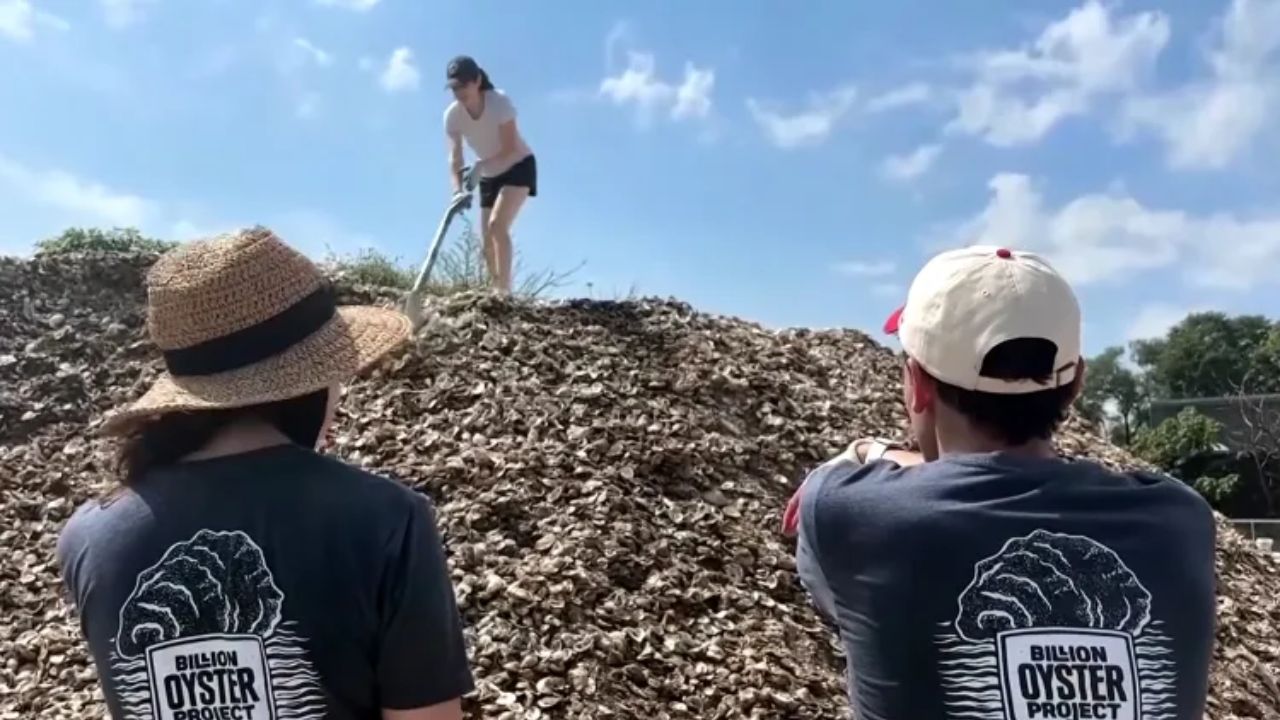
NEW YORK CITY, N.Y. — Every time diners order oysters at participating New York City restaurants, the empty shells could have a second life far beyond the dinner table.
Instead of going into the trash, millions of oyster shells are being collected and returned to New York Harbor as part of an ambitious restoration effort led by Billion Oyster Project.
The nonprofit is working with more than 80 partner restaurants, including P.J. Clarke’s and Jean-Georges Vongerichten’s ABC Kitchen, to restore oyster reefs that once played a major role in the harbor.
Since the project began in 2014, the organization says it has recycled more than 3.2 million pounds of oyster shells.
The shells are particularly valuable because young oysters need a hard surface to attach to when they begin life. Historically, they would have settled on the shells of older oysters.
But New York Harbor lost its natural oyster reefs more than a century ago.
“Every shell we recycle instead of sending to a landfill is a little more of that lost substrate given back,” a Billion Oyster Project spokesperson told.
How Restaurant Oyster Shells Return to the Harbor
The recycling process starts inside participating restaurants.
After diners finish their oysters, staff members separate the shells and save them rather than throwing them away. The shells are then transported to a transfer station before eventually reaching Governors Island.
There, the shells cure outdoors for close to a year. The lengthy process helps remove bacteria and leftover organic material before the shells can be used for restoration.
Once they are ready, Billion Oyster Project combines the recycled shells with concrete-based reef balls designed to mimic natural reef structures.
The materials are placed in tanks containing water from New York Harbor along with millions of oyster larvae.
Once the young oysters attach themselves to the recycled shells and structures, they can eventually be moved to restoration sites throughout the harbor.
Restaurants Say the Extra Work is Worth It
Sagaponack is among the restaurants participating in the shell recycling effort. Owner Richard Yu says the program fits naturally with the restaurant’s connection to seafood and the water.
“At Sagaponack, our restaurant is built around food that comes from the water. To me, it only makes sense that we do our small part to give something back,” Yu tells.
The restaurant separates and saves oyster shells for Billion Oyster Project, even though doing so can add another task during busy service.
“Instead of throwing away the oyster shells after our guests enjoy them, our team separates and saves them for Billion Oyster Project,” Yu says.
“Is it a hassle to do that during the frenzy of a Friday evening service? Absolutely. But it is so worth it.”
Yu says the effort demonstrates how small contributions can become significant when restaurants across the city participate consistently.
“Something that would otherwise be treated as garbage can become the foundation for new life in our harbor,” he says.
Millions of Oysters Are Already Being Restored
The scale of the effort continues to grow.
Billion Oyster Project says participating restaurants collectively send more than 300,000 pounds of oyster shells each year, equal to roughly 800 pounds every day.
The nonprofit says its restoration work has already helped restore more than 183 million oysters and approximately 19 acres of reef habitat.
Its long-term goal is even bigger: 1 billion oysters in New York Harbor by 2030.
The organization says that number represents an estimated threshold at which the oyster population could become self-sustaining and begin expanding more naturally.
“We hope to see introduced and wild oysters recruit to the structures with the reef expanding without us, a pattern we refer to as ‘self-sustaining,’” the nonprofit says.
Monitoring has already shown encouraging signs, with oysters surviving for years, reaching mature sizes at several restoration sites and new oysters naturally attaching to some reefs.
Oyster Reefs Could Help Protect New York Harbor
The project isn’t simply about bringing oysters back.
Billion Oyster Project says oyster reefs can provide habitat, strengthen shorelines, filter water, buffer storm surge and support biodiversity.
“Oyster reefs work as real climate infrastructure that filters water, buffers storm surge and rebuilds biodiversity,” a representative says.
The nonprofit hopes to eventually create “one connected metapopulation” of oyster reefs while providing a model that other coastal cities could follow.
The restoration effort also includes a major educational component. More than 17,000 volunteers have participated in cleaning shells and helping build reefs.
Billion Oyster Project says it wants young New Yorkers to better understand the natural environment surrounding their city.
“We believe that for restoration to be successful, the next generation of New Yorkers need to value nature and realize New York is home to great wild spaces too,” the organization says.
For the nonprofit, restoring the harbor means rebuilding both its physical ecosystem and the connection people have with it.
“Restoration gives the Harbor its physical and ecological foundation back, and education is what makes that recovery last, because it builds a culture of people who see the Harbor as something worth protecting.”
What do you think about NYC restaurants turning used oyster shells into new life for New York Harbor? Share your thoughts in the comments.