
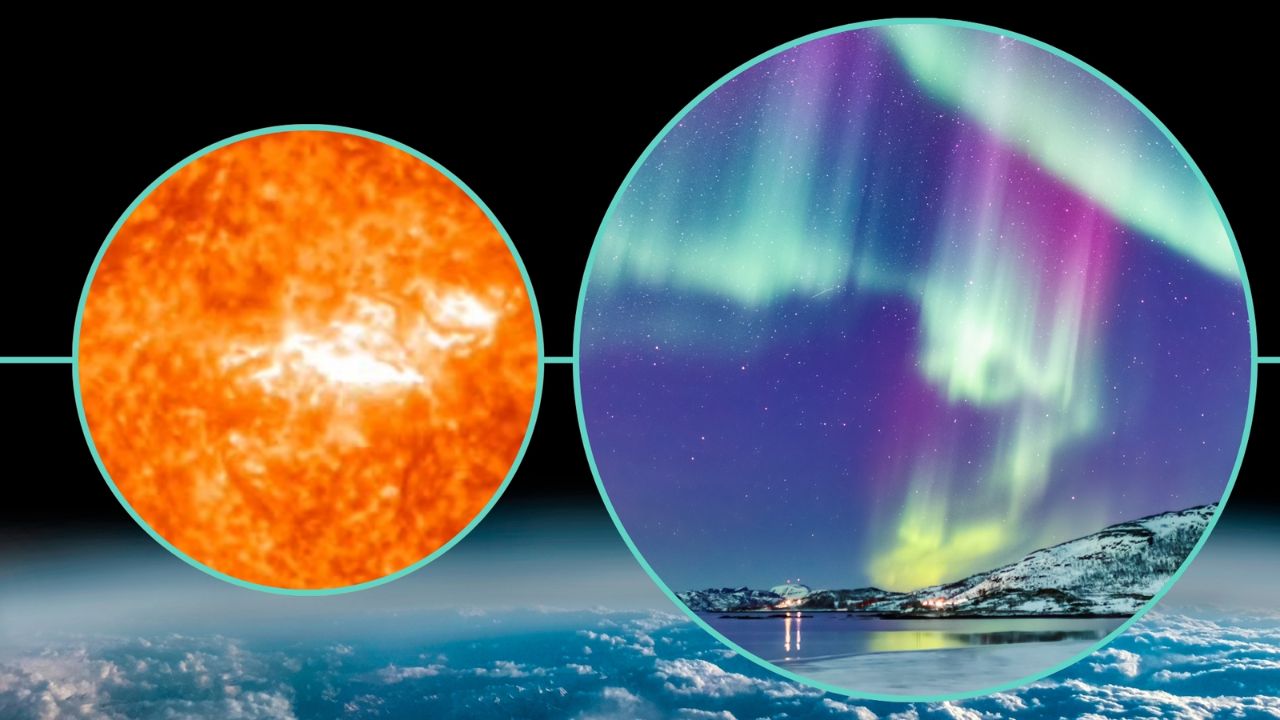
United States – The sun has unleashed a powerful M6.9 solar flare, sending a coronal mass ejection, or CME, racing through space toward Earth and raising the possibility of another Northern Lights display later this week.
The eruption peaked at 10:02 UTC on August 25, according to NOAA’s Space Weather Prediction Center. It came from active region 4513, which produced several M-class flares during the same period.
The M6.9 eruption was accompanied by a Type II radio sweep and a CME that was first observed shortly afterward. NASA’s CME database also links the eruption directly to the M6.9 flare.
Now, scientists are watching the CME’s journey toward Earth to determine whether it will produce enough geomagnetic activity to create a visible aurora.
CME Could Reach Earth Later This Week
A coronal mass ejection is an enormous cloud of solar plasma and magnetic field that can be launched into space during major solar eruptions.
When one of these eruptions is directed toward Earth, the material can interact with Earth’s magnetic field and trigger a geomagnetic storm. That interaction can also produce the colorful auroras commonly known as the Northern Lights.
Current modeling indicates that the CME associated with the M6.9 flare could reach Earth between Thursday and Friday, with some models putting the arrival around Friday morning. NASA’s CME modeling currently shows an estimated arrival around August 28, although forecasts can change as additional observations become available.
The strength of the resulting geomagnetic activity will depend heavily on the CME’s speed, direction and magnetic orientation when it reaches Earth.
Northern Lights Chances Could Increase Friday
The arrival of the CME could create a better opportunity for skywatchers to see the Northern Lights across parts of North America.
The CME is not the only factor scientists are watching. A high-speed solar wind stream is also expected to influence Earth’s space-weather environment around the same period.
If the CME arrives while that faster solar wind is interacting with Earth’s magnetosphere, the combined effects could increase geomagnetic activity and improve the chances of aurora displays. Space.com reported that NOAA has issued a geomagnetic storm watch for the coming period, with auroras possible on August 27 and 28.
However, that does not mean everyone across North America will see the lights.
Aurora visibility depends on the eventual strength of the geomagnetic storm, cloud cover, light pollution and location. Northern areas will generally have the best chance, while stronger-than-expected geomagnetic activity could allow the aurora to expand farther south.
What the Solar Flare Means for Earth
Solar flares are classified into five main categories: A, B, C, M and X, with each category representing a stronger level of flare activity.
An M-class flare is considered a significant eruption, while X-class events are the strongest category.
Solar flares can produce intense radiation that may affect radio communications, navigation systems and spacecraft operations. NASA notes that major solar activity can also pose risks for astronauts and space-based equipment.
A CME is different from the initial flash of radiation from a solar flare. It involves a huge amount of solar material being expelled into space, and its arrival can produce geomagnetic disturbances around Earth.
In this case, scientists are particularly interested in whether the CME will deliver a strong enough magnetic impact to produce a noticeable aurora.
Skywatchers Waiting for Friday Night Display
The coming days will provide a clearer picture of how much of an impact the solar eruption will have.
Forecast models are still being refined, and the exact timing and intensity of the CME’s arrival can change as new spacecraft observations become available.
For now, skywatchers in northern parts of North America have reason to keep an eye on the forecast through Thursday and Friday.
If the CME combines with favorable solar-wind conditions and produces stronger geomagnetic activity, the result could be a colorful display across the night sky.
Would you stay up late to watch the Northern Lights if they become visible in your area? Share your thoughts in the comments.