
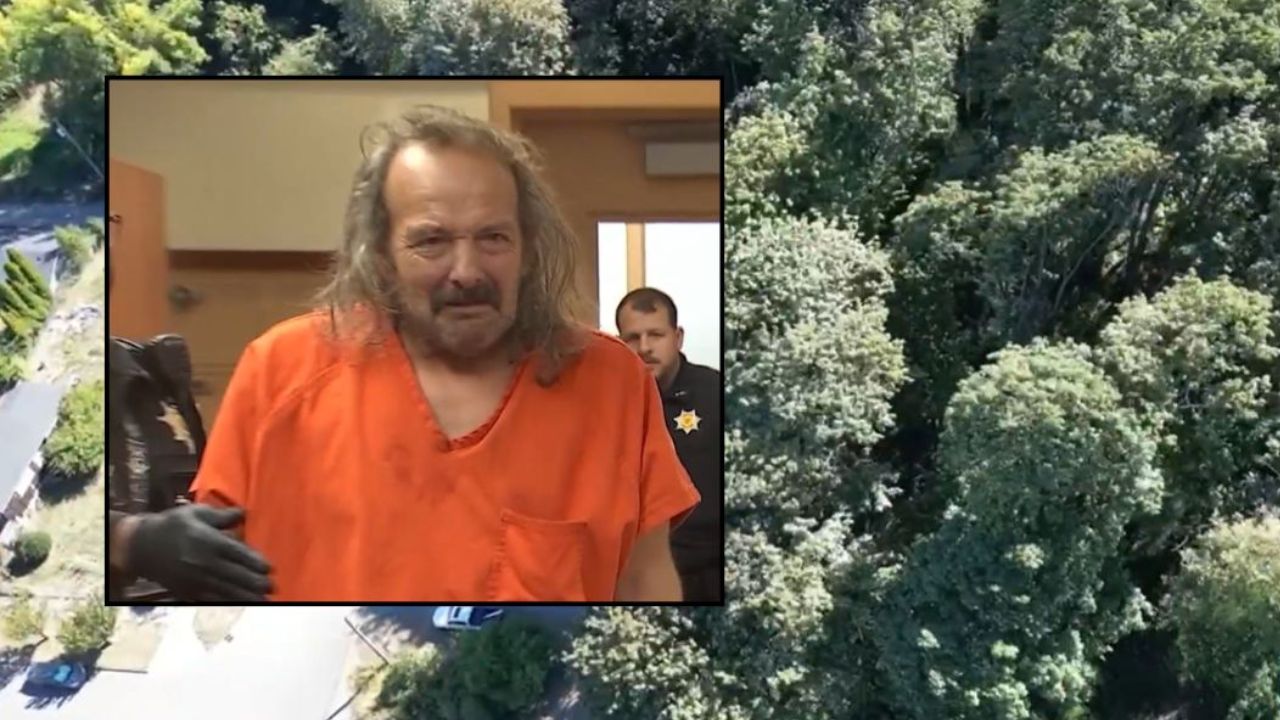
TACOMA, Wash. — A nearly five-year-old murder investigation has taken a major turn after police say DNA evidence connected a Washington man to a woman who was found dead in a wooded area.
Edwin Newlander, 59, was charged with second-degree murder on Monday, nearly five years after authorities discovered the body of a woman identified in court documents only by the initials K.S.
Police responded to reports of a dead body on Oct. 12, 2021, according to a probable cause statement. During the examination of the victim, investigators found male DNA beneath her fingernails on both hands.
Authorities determined that K.S. had been strangled to death, but the DNA evidence did not immediately identify a suspect. The case remained unresolved for years until investigators were able to compare the DNA with evidence from a more recent investigation.
DNA Links Newlander to Two Other Cases
The investigation gained momentum in March when detectives reportedly matched the DNA recovered from K.S. with a sample associated with a man accused of attacking another woman in 2025.
That woman, identified as J.H., told a nurse conducting her rape examination that she had been sexually assaulted by a man named “Ed.” She described the suspect as being in his 50s, short, stocky and balding with long hair on the sides.
Police said the description appeared to match Newlander.
Investigators then discovered another potential connection. DNA collected from J.H. reportedly matched evidence from a separate 2019 sexual assault case involving a woman identified in court documents as T.D.H.
T.D.H. told police in October 2019 that she had been abducted and sexually assaulted by a white male in his 50s.
The DNA connection between the two sexual assault cases gave investigators additional grounds to consider Newlander as a suspect.
Cigarette Butt Becomes Key Evidence
Police eventually got an opportunity to obtain a DNA sample directly from Newlander. In June, officers pulled him over during a traffic stop after allegedly observing him driving with a suspended license.
During the stop, police said Newlander discarded a cigarette butt. Investigators collected the cigarette, hoping it could provide a DNA sample for comparison.
The strategy appeared to pay off.
In August, detectives received a report from the Washington State Police Crime Lab stating that the DNA recovered from the cigarette matched DNA samples connected to the two sexual assault cases.
The lab also determined that Newlander was a “possible contributor” to the DNA found on K.S., according to the probable cause statement.
That evidence helped move the long-running murder investigation toward an arrest.
Newlander Gives Police Conflicting Account
Police questioned Newlander about K.S. on Sept. 2.
During the interview, Newlander acknowledged recognizing the woman and said he had picked her up in his truck because he wanted to “make a new friend.” He claimed K.S. attacked him during their encounter and reportedly told investigators, “That girl is nuts.”
Newlander initially said he eventually asked K.S. to leave his truck and denied being forceful with her. He later changed his account, saying K.S. stayed with him in a different vehicle and that they “messed around a few times.”
According to the probable cause statement, Newlander told investigators that the last time he saw K.S., she had gotten out of his vehicle and walked toward McKinley Park, which is located near the area where her body was later discovered.
He denied harming her.
Murder Charge Filed as Investigation Continues
Newlander has now been charged with second-degree murder in connection with K.S.’s death. However, authorities have not charged him in connection with the two sexual assault cases mentioned in the investigation.
The DNA evidence from those cases was reportedly used as part of the broader investigation that eventually connected Newlander to the murder case.
Newlander is scheduled to appear in court again on Sept. 28.
As the case moves forward, prosecutors will have to establish how the DNA evidence, Newlander’s account of his interactions with K.S. and the circumstances surrounding her death fit together.
For now, the arrest marks a significant development in a case that had remained unresolved for nearly five years.
What do you think about the DNA evidence that helped investigators make an arrest years after the woman’s death? Share your thoughts in the comments.