
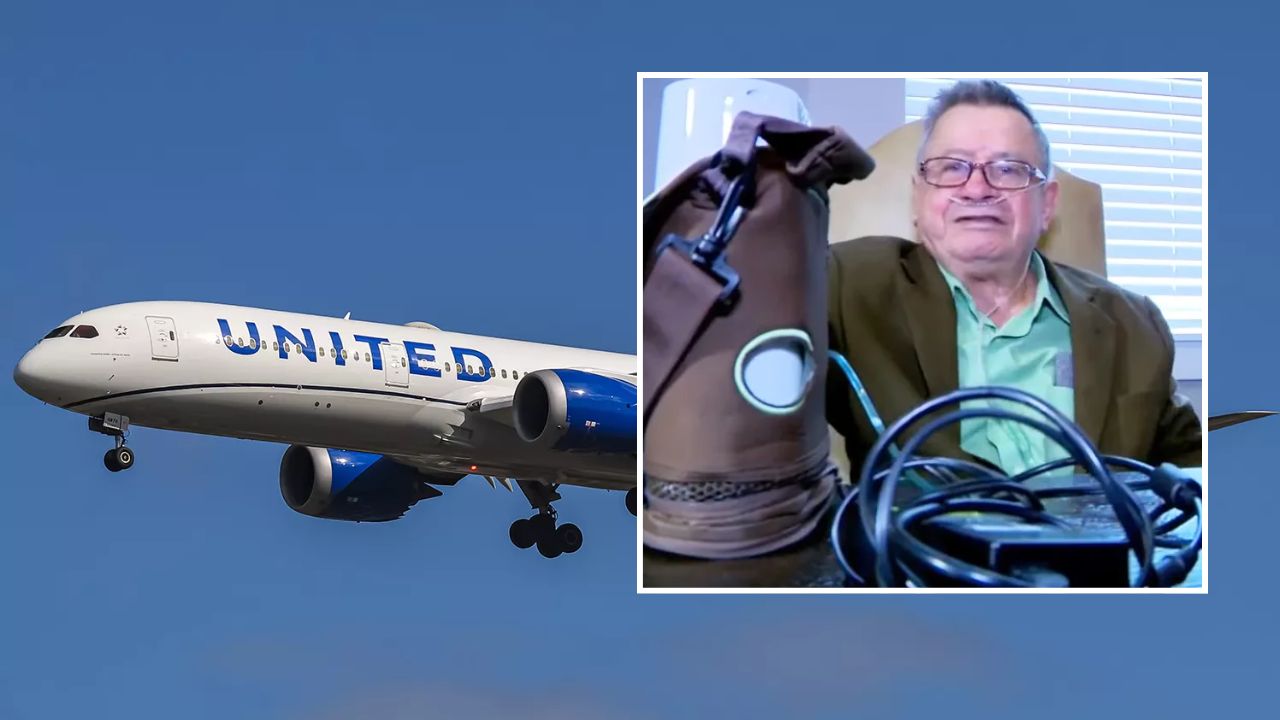
SALT LAKE CITY, Utah — A 71-year-old United Airlines passenger says his recent flight became a frightening ordeal after his oxygen concentrator ran out of power and he was allegedly unable to get the support he needed from the aircraft’s power outlets.
Jaime Jesus Carvajal told that he suffers from chronic obstructive sleep apnea and chronic obstructive asthma, conditions that require him to use a breathing device “day and night.”
Carvajal was traveling to Colombia because of his son’s health problems. According to his account, his sister purchased his ticket in Dallas, Texas, and he was instructed to check his oxygen concentrator and provide the necessary medical documentation at the airport.
He says he followed those instructions and presented a medical certificate from a pulmonology clinic stating that he needed oxygen for the entire duration of the flight.
Carvajal claims United employees reviewed the documentation and assured him that he would be able to use his device onboard.
“I spoke with the cabin crew, I spoke personally with the check-in agent, and they gave me the evaluation that yes, everything was fine,” he said.
Oxygen Power Allegedly Ran Out During Flight
The situation reportedly changed about two hours into the flight from Salt Lake City to Houston.
Carvajal says the battery powering his oxygen concentrator ran out while he was sitting in seat 37F near the window.
“Two hours into the flight from Salt Lake City to Houston, the charge ran out,” Carvajal said.
He says he alerted a flight attendant, who then moved him to seat 6C in the business-class cabin.
According to Carvajal, the move initially appeared to solve the problem because the device briefly connected to the aircraft’s power supply.
“There, the connector lit up for a moment. I fell asleep, but that thing, it didn’t work… It turned off,” he said.
Carvajal’s attorney, David Head, told that neither of the outlets was working before the passenger’s oxygen device ran out of power.
The allegation has raised questions about whether enough assistance was provided to a passenger who had informed the airline of his medical requirements before traveling.
Passenger Says His Health Later Worsened
Carvajal eventually reached Panama, where he says another airline provided the oxygen support he needed. However, his attorney claims the incident had consequences beyond the flight itself.
According to Intermountain Health records reviewed by Fox 13, Carvajal has since been evaluated for increased headaches that disrupt his sleep and kidney function.
Head argues that the situation could have been avoided if the airline had properly addressed the passenger’s oxygen needs.
“It easily could’ve been prevented. United had multiple chances to do the right thing and they didn’t do it,” Head said.
The attorney says the family plans to file a civil complaint against United Airlines in the coming months. He also said the legal process could take two to three years before a decision is reached.
United Passenger Says Airline Offered $150 Credit
After the incident, Carvajal says he contacted United Airlines to raise concerns about what happened. According to his account, the airline offered him a $150 flight credit. The offer left Carvajal dissatisfied, particularly given the seriousness of his allegations.
“To United, I would tell them to train their employees to be more careful with us elderly people who are vulnerable,” Carvajal said.
A United Airlines spokesperson declined to comment on the specific matter.
However, United’s contract of carriage states that passengers may use FAA-approved portable oxygen concentrators at no additional cost, provided they meet the airline’s requirements.
United Rules Require Advance Notice and Batteries
United’s policy says passengers using approved portable oxygen concentrators must notify the airline at least 48 hours before travel.
Passengers are also required to carry enough batteries to operate the device for 1.5 times the length of the flight and any connections.
The airline also makes clear that it cannot guarantee passengers a seat with in-seat power during their journey.
Those requirements are particularly important for passengers who depend on portable oxygen equipment because battery life and access to aircraft power can become critical during a long trip.
The FAA also states that airlines are not required to provide oxygen service, and many airlines do not offer it.
Carvajal’s allegations have not been established in court, and United has declined to comment on his individual case. His attorney says a civil complaint is expected in the coming months, potentially setting up a lengthy legal dispute over what happened during the flight.
What do you think about Carvajal’s experience and the reported $150 credit offer? Share your thoughts in the comments.